
The Short Answer, and Why It Is Not Very Useful
National averages put a kitchen remodel somewhere around $25,000, with the full range running from about $15,000 to $60,000 and custom work going well past that. Remodeling Magazine's Cost vs. Value report tracks a minor midrange kitchen remodel and a major one as separate projects for exactly this reason, because they are not the same job.
That average does not help you much. A $25,000 average is the midpoint between somebody who painted their cabinets and somebody who moved a wall. What you want to know is what your money actually buys. Quartz versus granite is its own decision. That split is in quartz vs granite countertops in Topeka.
I am Ryan Felix and I own Kingdom Builders Co. here in Topeka. What follows is how I think about kitchen budgets when a homeowner in Shawnee County calls me, broken into four tiers, with what is realistic at each. These are market ranges rather than Kingdom quotes, because the only real number for your kitchen comes from standing in it.
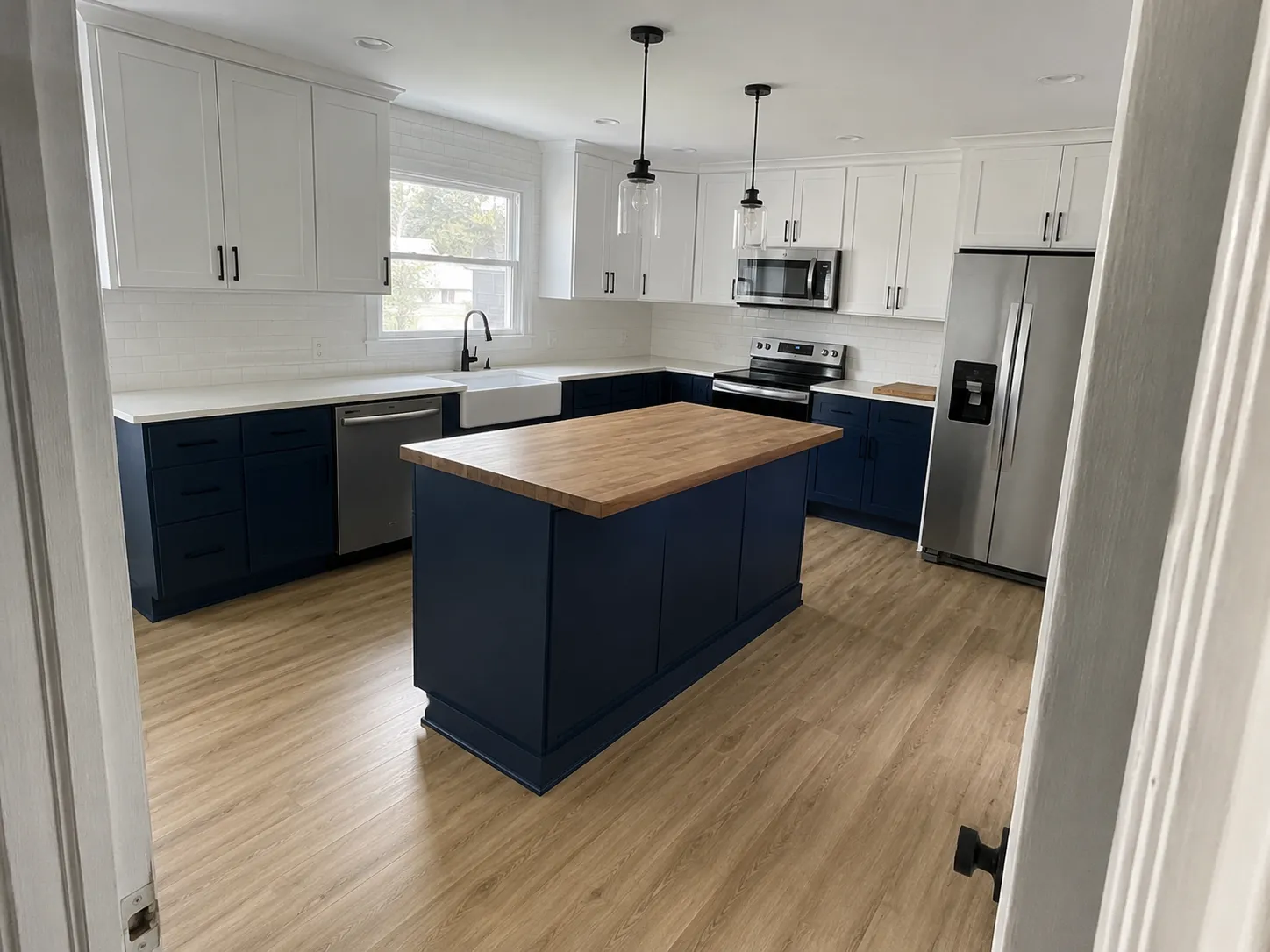
What Each Budget Actually Buys
Around $10,000: the cosmetic refresh
At this level nothing moves. The layout stays exactly where it is, the plumbing stays where it is, and the electrical stays where it is. What you change is what you see.
That typically means refacing or repainting the existing cabinet boxes, new countertops in laminate or butcher block, a tile backsplash, new hardware, a new sink and faucet, and paint. If your cabinet boxes are solid, refacing is the highest-return dollar in the whole kitchen, because you are keeping the expensive part and replacing the part you look at.
Where this tier breaks down is if the boxes are particle board and already swelling at the sink base. Refacing a failing box is throwing money at a problem that comes back. Open a door and press on the bottom of the cabinet under your sink. If it gives, refacing is not your answer.
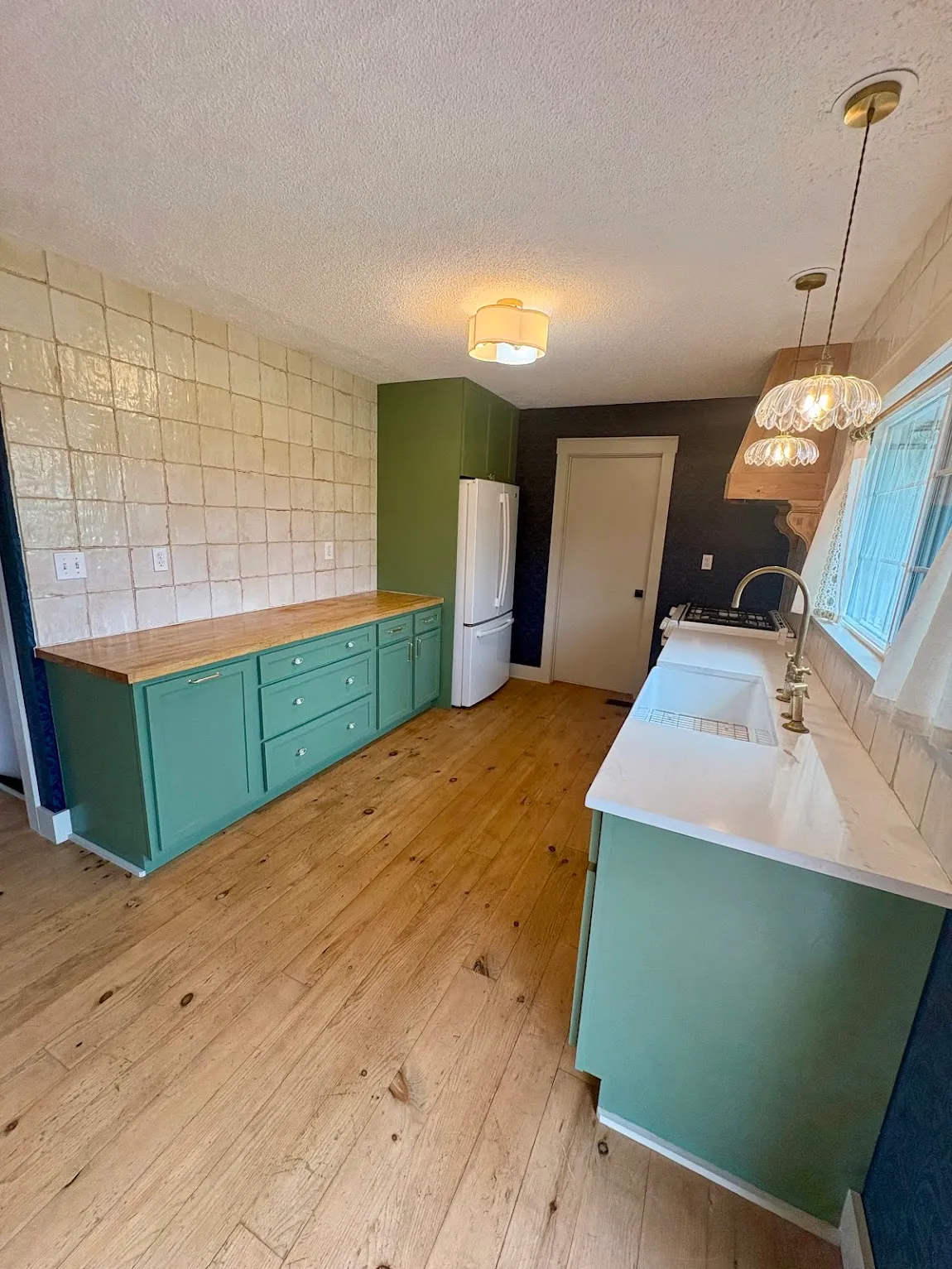
Around $25,000: new cabinets, same footprint
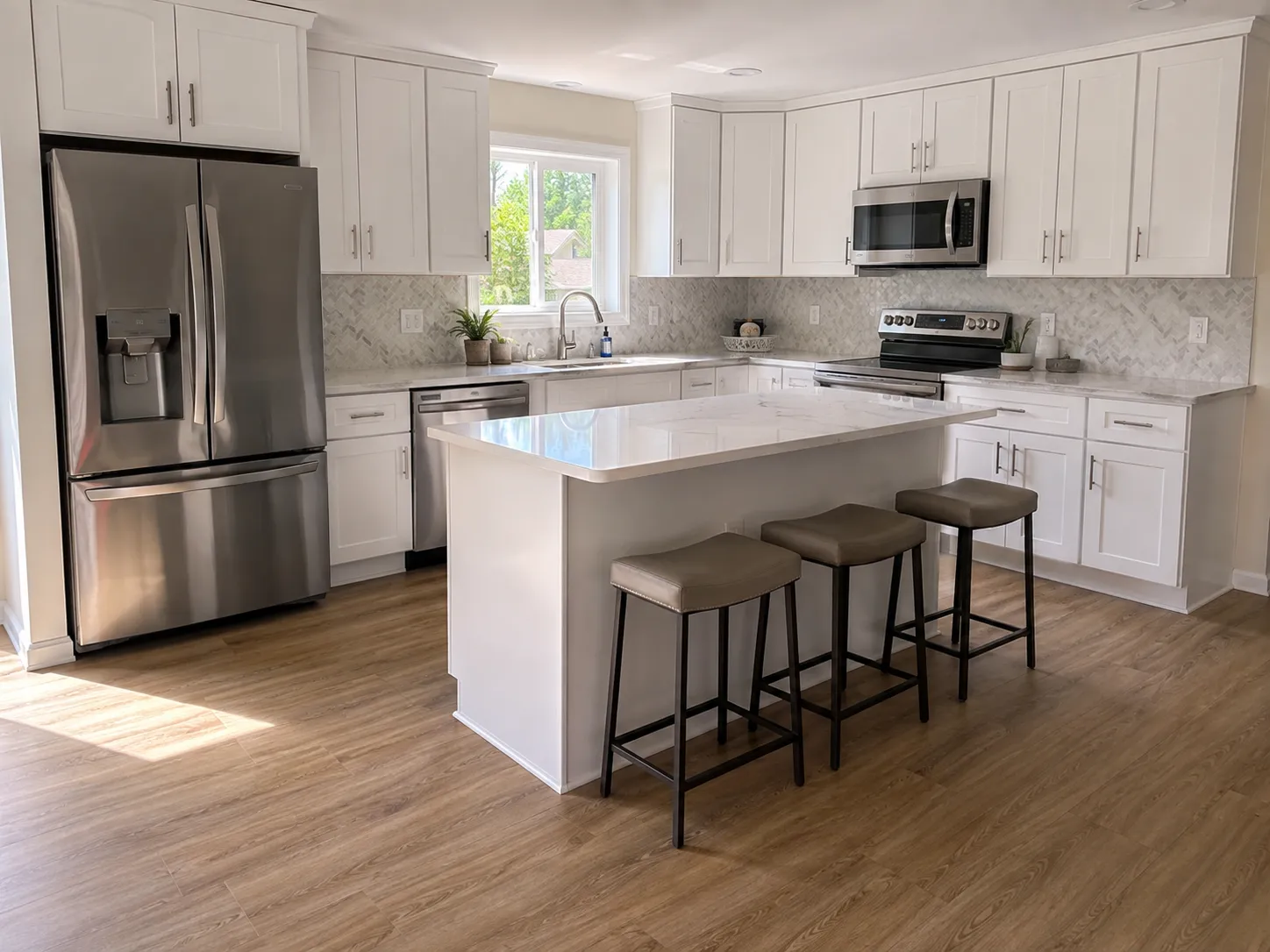
This is the most common real kitchen remodel, and it is where most Topeka homeowners land. Everything comes out and new goes back in the same places: new stock or semi-custom cabinets, quartz or granite counters, tile backsplash, new flooring, new sink and faucet, new lighting, and paint. Appliances are usually the homeowner's separate purchase.
Keeping the sink, stove, and refrigerator in their existing positions is what makes this number work. No plumbing gets moved, no gas line gets relocated, no wall comes down. You get a kitchen that looks and functions like new, in a layout you already know works.
The upgrade that pays for itself here is plywood cabinet boxes instead of particle board. It costs more up front and it is the difference between cabinets that last twenty years and cabinets that sag under stone counters.
Around $45,000: the layout changes
Now we are moving things. An island goes in, or a wall comes out to open the kitchen to the living room, or the sink moves under the window where it should have been all along.
The jump from the previous tier is not the cabinets, it is the trades. Moving a sink means a plumber opening the floor. Adding an island with a sink or a cooktop means running supply, drain, and electrical through the floor to the middle of the room. Removing a wall means confirming whether it is load bearing and, if it is, sizing and installing a beam. Every one of those brings permits and inspections.
This tier usually also buys semi-custom cabinets with real storage, a full appliance package, recessed and under-cabinet lighting, and better tile.
$70,000 and up: custom
Fully custom cabinetry built to your dimensions, high-end appliances, a large island, specialty storage, custom range hood, and finishes without compromise. Structural work, expanding into an adjacent room, or relocating the kitchen entirely lives here too.
Worth being honest about resale: in most Topeka neighborhoods, a $90,000 kitchen does not return $90,000 when you sell. If you are staying in the house for a decade, spend it and enjoy it. If you are remodeling to sell in two years, the $25,000 tier returns better.
"They had to relocate some outlets and hook up some plumbing. They worked diligently, took just a couple of days, and cleaned up flawlessly afterwards. Very happy."
David TroupRead on Google →
What Older Topeka Homes Add to the Bill
A lot of the housing here went up between the 1920s and the 1960s, and those kitchens carry costs a national calculator does not know about.
Not enough circuits. This is the big one. A kitchen from 1955 might run on one or two circuits. Modern code wants dedicated 20-amp circuits for the refrigerator, dishwasher, and microwave, plus GFCI-protected small appliance circuits at the counter. If your panel has room, adding those is manageable. If the panel is full or still a fuse box, you are looking at a sub-panel or a service upgrade, and that is thousands before a single cabinet arrives.
Plaster over wood lath. Plaster does not cut or patch like drywall. Anywhere new cabinets meet old plaster, getting a flat, plumb surface takes extra work, and older plaster walls are frequently neither.
Floors that are not level. Settling over seventy years means a floor that can be off by half an inch or more across a run of cabinets. Cabinets have to be shimmed level regardless of what the floor is doing, or the counters will not sit right and the doors will not line up.
Galvanized supply lines. If the house still has galvanized steel piping, it has been corroding shut for decades. Once the wall is open behind the sink base, replacing that run is worth doing while you can reach it.
Small footprints. Kitchens from that era are often galley-shaped and genuinely small. That cuts both ways: fewer linear feet of cabinet and counter means the materials cost less, but the labor per square foot goes up because everything is a tight fit and there is nowhere to stage tools.
None of this should scare you off. It is the reason a good estimate includes an allowance for what is behind the wall, and the reason I will not quote a kitchen over the phone.

Go open the cabinet under your kitchen sink and press on the floor of it with your thumb. If it flexes or feels soft, your boxes are particle board and they have been taking on moisture. That single test tells you whether you are in the refacing conversation or the new cabinet conversation, and it moves your budget by fifteen thousand dollars. Do it before you call anybody, and mention what you found. Any contractor worth hiring will want to know.
Where the Money Goes
Across the industry, a full kitchen remodel breaks down roughly like this:
- Cabinets, about a quarter to a third of the budget. Always the largest line. Stock, semi-custom, and custom is the ladder, and the box material matters more than the door style.
- Labor, about 20 to 35 percent. Demo, carpentry, plumbing, electrical, tile, and finish work.
- Countertops, about 10 to 15 percent. Laminate at the bottom, then butcher block, then granite and quartz. Square footage and edge profile move it.
- Appliances, about 10 to 15 percent, and entirely up to you. This is the single easiest line to control.
- Flooring, backsplash, lighting, plumbing fixtures, paint, making up the rest.
Two of those are where homeowners find real savings without regret: appliances and countertop material. Buying a mid-range appliance package instead of a premium one, or quartz instead of an exotic natural stone, changes the total meaningfully and changes daily life almost not at all. Compare quartz and granite in quartz vs granite countertops in Topeka, and see install sequencing on our countertop installation page.
The place not to save is what is behind the surface. Cheap cabinet boxes, skipped electrical, and thin underlayment are the decisions you pay for twice.
Get a straight answer and a free written estimate on your kitchen remodel, no pressure, no sales games.
(785) 329-4551How Long It Takes
Budget and timeline are connected, because time on site is labor.
- Cosmetic refresh: one to two weeks.
- New cabinets, same layout: four to six weeks on site, but cabinets are the long pole. Semi-custom and custom orders run four to eight weeks from the day you sign off on the design, so the calendar starts before anyone shows up.
- Layout change: six to nine weeks, plus inspection scheduling.
- Custom: ten weeks and up.
Plan on being without a kitchen for most of it. We set up a temporary station with the refrigerator, microwave, and a coffee maker somewhere out of the work zone, and it makes a real difference. See the full week-by-week breakdown on our kitchen remodeling page.
Financing Available, Start Now and Pay Over Time
Your kitchen remodel should not have to wait for the perfect month. We offer flexible financing so you can split the project into affordable monthly payments and get started today.
How to Compare the Quotes You Get
Get three. Then read past the number at the bottom.
- Cabinet construction, spelled out. Plywood or particle board box, and what the drawer slides and hinges are. Two quotes with the same total can be very different cabinets.
- Countertop allowance in dollars per square foot, so you know what happens when you pick something you like better than the sample.
- Whether electrical is included. If a quote says nothing about circuits in a 1950s house, either the contractor has not thought about it or it is coming as a change order.
- Who pulls the permits. Moving plumbing or altering electrical in Topeka requires one.
- A stated contingency for what is found behind the walls, and how change orders get priced.
- The payment schedule. A deposit is normal. A demand for most of the money before work starts is not.
Be skeptical of a bid that comes in far under the other two. It is usually either a different scope or an allowance set low enough that the change orders are already planned.
Getting a Real Number for Your Kitchen
Everything above is a range. Your kitchen has a specific size, a specific panel, a specific floor, and specific walls, and those decide your actual number.
Kingdom Builders Co. is owner-operated. I am on your job, I coordinate the plumbing, electrical, cabinetry, tile, and finish work under one contract, and I am the person you talk to when something needs a decision. We are fully insured, we hold a 4.9 rating across 38 five-star reviews, and we work throughout Topeka and Shawnee County.
The estimate visit is free and there is nothing attached to it. We measure, look at your panel and your plumbing, and give you a written breakdown you can compare against anyone else's. Request your free kitchen estimate or call (785) 329-4551.
Frequently Asked Questions
What is the average cost of a kitchen remodel in Topeka, KS?
Most full kitchen remodels in the Topeka area land between $20,000 and $45,000 when the layout stays the same. A cosmetic refresh runs closer to $10,000, and custom work with layout changes starts around $45,000 and goes up. These are market ranges, not Kingdom Builders quotes.
What does a kitchen remodel cost per square foot?
Per square foot is a rough guide at best, because kitchen cost tracks linear feet of cabinet and counter far more than floor area. A large open kitchen with one wall of cabinets can cost less than a small galley with cabinets on both sides. Ask for a scope breakdown instead of a square foot number.
Can I remodel a kitchen for $10,000?
Yes, if the layout stays put and the cabinet boxes are sound. That budget covers refacing or repainting cabinets, new counters, a backsplash, hardware, a sink and faucet, and paint. It does not cover new cabinets or moving plumbing.
What is the most expensive part of a kitchen remodel?
Cabinets, typically a quarter to a third of the budget, more than countertops, flooring, or appliances.
Do I need a permit to remodel my kitchen in Topeka?
If you are moving plumbing, altering electrical, or removing a wall, yes, and it comes with inspections. Replacing cabinets and counters in place usually does not. We pull the permits on our projects.
Is a kitchen remodel worth it for resale?
A midrange remodel returns better than a high-end one. Cost vs. Value has consistently shown minor midrange kitchen work recouping a higher percentage than major upscale work. If you are selling soon, keep the scope tight. If you are staying, build the kitchen you want.
How long will I be without a kitchen?
Four to six weeks for a typical remodel that keeps the layout, longer if plumbing moves. Cabinet lead times of four to eight weeks happen before demo starts, so the total calendar is longer than the time anyone is in your house.
Who Wrote This
Ryan Felix wrote this. He owns Kingdom Builders Co. in Topeka.
- Written by the owner
- Ryan Felix runs the crew and is on site for the work. These ranges come from real jobs, not a calculator.
- Based in Topeka
- 6121 SW 22nd Park. We work in Topeka and throughout Shawnee County.
- 4.9 stars, 38 reviews
- Verified Google reviews from Shawnee County homeowners.
- Fully insured
- Coverage in place on every project, and we pull the permits our work requires.
Written By
Ryan Felix
Owner, Kingdom Builders Co.
Ryan Felix has hands-on experience working on homes, decks, fences, bathrooms, kitchens, and outdoor living spaces. He founded Kingdom Builders Co. in Topeka with a simple conviction: show up when you say you will, do honest work, and charge a fair price. Ryan is personally on every job from estimate to final walkthrough.
Ready to Start Your Project?
Get a free estimate from Kingdom Builders Co. today.