
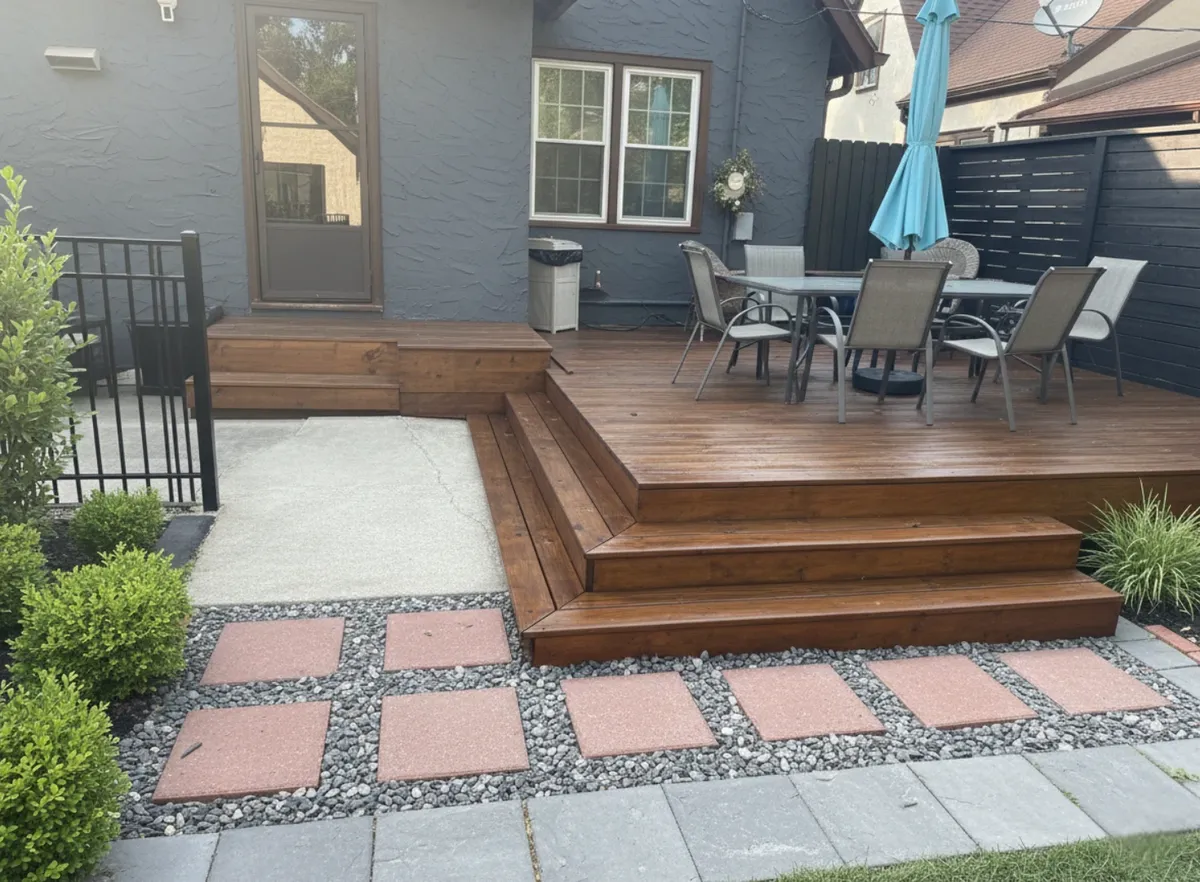
Why Kansas Weather Matters for Deck Material Selection
Kansas puts deck materials through a punishing annual cycle: triple-digit summer heat, sub-zero winter cold, intense UV exposure, ice storms, high winds, and dramatic temperature swings that can span 50 degrees in a single week. Topeka averages 65 days above 90°F, 25 days below 20°F, and receives about 36 inches of rain and 15 inches of snow annually. Those conditions make material selection one of the most important decisions in any deck building project.
The deck material you choose determines how your deck looks, performs, and lasts through years of Kansas weather. It also determines how much time and money you will spend on maintenance. Below we compare the four most common decking materials used in the Topeka area, with honest assessments of each based on our experience building decks across Shawnee County.
Composite Decking
Best for: Low-maintenance homeowners who want lasting beauty without annual staining.
Composite decking from manufacturers like Trex, TimberTech, and Fiberon is engineered specifically to resist the environmental stresses that destroy natural wood. Modern composite boards are made from a combination of recycled wood fibers and plastic polymers, capped with a protective polymer shell that resists fading, staining, scratching, and mold growth. They do not splinter, warp, or require chemical treatments.
Composite decking performs exceptionally well in Kansas because it handles UV exposure and temperature extremes without the cracking and splitting that affects natural wood. The capped polymer surface sheds moisture rather than absorbing it, which eliminates the freeze-thaw cycle that damages wood boards from the inside out. Most premium composites carry 25-year or lifetime warranties on structural integrity and fade resistance.
The main drawback of composite decking is heat retention. Dark-colored composite boards can get uncomfortably hot in direct Kansas summer sun. Lighter colors mitigate this significantly. We typically recommend lighter tones for sun-exposed deck areas and reserve darker colors for shaded sections or covered porches.
Installed cost: $45–$70 per square foot (including substructure).
Typical 300 sq ft deck: $13,500–$21,000 installed.
Annual maintenance cost: $0–$50 (occasional cleaning).
Expected lifespan: 25–50 years.
Pressure-Treated Wood
Best for: Budget-conscious homeowners who do not mind annual maintenance.
Pressure-treated Southern Yellow Pine remains the most affordable decking material and performs adequately in Kansas when properly maintained. The chemical treatment (typically micronized copper azole or MCA) resists rot and insect damage, and the wood accepts stain and sealant well.
The reality in Kansas: pressure-treated wood demands consistent annual or biennial maintenance. Without cleaning, staining, and sealing, the boards will crack, split, warp, and turn gray within 2–3 years. Kansas summers accelerate UV damage, and the freeze-thaw cycle works moisture into every crack and joint. Homeowners who skip maintenance find their decks deteriorating rapidly, sometimes needing board replacement within 5–7 years.
That said, a well-maintained pressure-treated deck can last 15–20 years and look attractive throughout its life. The key is committing to the maintenance schedule before you commit to the material.
Installed cost: $25–$40 per square foot (including substructure).
Typical 300 sq ft deck: $7,500–$12,000 installed.
Annual maintenance cost: $200–$500 (cleaning, staining, sealing).
Expected lifespan: 15–20 years (with maintenance).
Cedar Decking
Best for: Homeowners who want natural beauty and are willing to invest in maintenance.
Western Red Cedar offers natural resistance to rot and insects through its inherent oils, a warm reddish-brown tone, and a pleasant aroma. Cedar is naturally more dimensionally stable than pressure-treated pine, which means less warping, cupping, and splitting. Many homeowners in established Topeka neighborhoods like College Hill and Potwin Place prefer cedar for its aesthetic warmth and character.
Cedar still requires regular sealing and staining in the Kansas climate, typically every 1–2 years. Without protection, cedar will weather to a silver-gray color and eventually check and crack. Cedar is also softer than pressure-treated pine, making it more susceptible to dents and scratches from furniture and foot traffic.
Installed cost: $35–$55 per square foot (including substructure).
Typical 300 sq ft deck: $10,500–$16,500 installed.
Annual maintenance cost: $200–$500 (cleaning, staining, sealing).
Expected lifespan: 20–25 years (with maintenance).
Hardwood (Ipe and Similar Tropical Hardwoods)
Best for: Homeowners who want the most durable natural wood and are comfortable with premium pricing.
Tropical hardwoods like Ipe (Brazilian Walnut) are extraordinarily dense and naturally resistant to rot, insects, mold, and fire. Ipe decking is rated for 40–75 year lifespans even with minimal maintenance. It handles Kansas weather better than any other natural wood because its density prevents moisture absorption.
The downsides are significant: Ipe costs roughly twice as much as composite, is extremely heavy, and requires specialized tools and fasteners for installation. It also must be oiled annually to maintain its rich brown color; otherwise it weathers to a silver-gray (which some homeowners prefer).
Installed cost: $60–$90 per square foot (including substructure).
Typical 300 sq ft deck: $18,000–$27,000 installed.
Material Comparison Table
| Material | Cost/Sq Ft | 300 Sq Ft Deck | Annual Maintenance | Lifespan | Kansas Performance |
|---|---|---|---|---|---|
| Pressure-Treated Wood | $25–$40 | $7,500–$12,000 | $200–$500 | 15–20 yrs | Good (with maintenance) |
| Cedar | $35–$55 | $10,500–$16,500 | $200–$500 | 20–25 yrs | Good (with maintenance) |
| Composite | $45–$70 | $13,500–$21,000 | $0–$50 | 25–50 yrs | Excellent |
| Ipe Hardwood | $60–$90 | $18,000–$27,000 | $100–$300 | 40–75 yrs | Excellent |
Total Cost of Ownership Over 20 Years
When comparing deck materials, the initial installed price is only part of the picture. Maintenance costs accumulate significantly over time, and replacement timelines differ dramatically. Here is what a 300 sq ft deck costs over a 20-year period:
Pressure-treated wood: $10,000 initial + $7,000 maintenance (20 years × $350 avg) = $17,000 total, and you may need to replace boards starting around year 12–15.
Cedar: $13,500 initial + $7,000 maintenance = $20,500 total, with board replacements starting around year 15–18.
Composite: $17,000 initial + $500 maintenance = $17,500 total, with the deck still in excellent condition at year 20.
This is why we recommend composite for most Topeka homeowners. Despite the higher upfront cost, the total cost of ownership over 20 years is actually comparable to or less than wood, and you never spend a weekend staining your deck.
Our Recommendation for Topeka Homeowners
For most homeowners in the Topeka area, we recommend composite decking for its combination of durability, appearance, and long-term value. The higher upfront cost is offset by decades of virtually zero maintenance and a significantly longer lifespan. For homeowners on a tighter budget who are committed to annual maintenance, pressure-treated wood is a solid choice that performs well when properly cared for.
We also recommend matching your substructure material to Kansas conditions. Even when using composite decking boards, the underlying frame (joists and beams) is typically pressure-treated lumber rated for ground contact. Proper flashing, joist tape, and adequate ventilation extend the life of your substructure well beyond the warranty period.
Frequently Asked Questions
Can I put composite decking on my existing wood frame?
Sometimes. If your existing substructure is structurally sound, level, and properly spaced for composite boards (typically 16-inch joist spacing or less), new composite decking can be installed on the existing frame. We inspect the substructure thoroughly before recommending this approach. In many cases, it is more cost-effective to replace the entire structure for long-term reliability.
Does composite decking get too hot to walk on barefoot?
Dark-colored composite boards can get noticeably warm in direct summer sun, but modern capped composites are significantly cooler than earlier generations. Choosing lighter colors, adding shade structures, or using outdoor rugs in high-traffic barefoot areas all help. It is rarely a deal-breaker for Topeka homeowners.
How long does a deck take to build?
A typical 200–400 sq ft deck takes 3–7 days to build depending on complexity, height, and permit requirements. Multi-level decks, covered porches, and projects requiring significant concrete work may take longer. We provide detailed timelines during the estimate process.
Do I need a permit for a deck in Topeka?
Yes. The City of Topeka requires a building permit for most deck constructions and significant deck modifications. The permit ensures the structure meets building codes for footings, framing, railing, and stairs. Kingdom Builders Co. handles the entire permitting process.
Start Planning Your Deck Project
Ready to discuss materials and design for your Topeka deck? Call Kingdom Builders Co. at (785) 329-4551 for a free consultation, or visit our contact page to request an estimate online. You can also explore our deck building services to see examples of our work across the Topeka area.

Written By
Ryan Felix
Owner, Kingdom Builders Co.
Ryan Felix has hands-on experience working on homes, decks, fences, bathrooms, kitchens, and outdoor living spaces. He founded Kingdom Builders Co. in Topeka with a simple conviction: show up when you say you will, do honest work, and charge a fair price. Ryan is personally on every job from estimate to final walkthrough.
Ready to Start Your Project?
Get a free estimate from Kingdom Builders Co. today.